The population of seniors in North Carolina is growing. While people of all ages have trouble affording housing, seniors face an additional challenge: housing costs and support costs—costs for the services many need as they age—compete for limited financial resources. Age frequently brings income limitations (from fixed incomes, retirement, inability to continue working or losing a spouse’s income due to widowhood), which impact the ability to afford both housing and services. Because many seniors prefer to remain in their current homes[i], preserving, repairing and adapting existing housing are essential investments to support aging in place.
The Senior Population is Growing
In North Carolina, the number and share of the state’s population that are seniors are increasing.
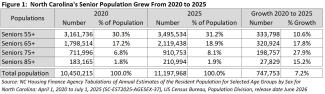
Looking ahead, the number of households headed by someone 80+ is expected to double from 2021 to 2040.[ii] By 2032, North Carolina is expected to have more seniors 65+ than children younger than 18.[iii]
Housing for Seniors
In North Carolina, most seniors live in homes they own or rent. See Figure 2. The National Council on Aging summarizes the range of housing options for seniors, depending on their needs, resources and desires, as:
- Aging-in-place
- Continuing care retirement communities
- Assisted living
- Nursing homes
- Cohousing
- Village model membership communities
- Independent living
- HUD Section 202 housing[iv].[v]
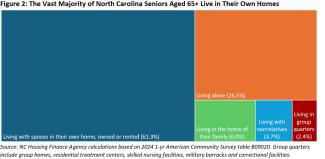
While many of the senior-specific housing models are rental housing, the majority of seniors in North Carolina are homeowners. Approximately 80.8% of North Carolina households headed by seniors age 65+ are homeowners, while 19.2% rent.[vi]
The cost of housing can be daunting, particularly for seniors on fixed incomes. As of 2023, one in ten seniors lived below the poverty level.[vii] In North Carolina, three in ten households headed by seniors 65+ are cost burdened, which means they pay more than 30% of their income for housing.[viii]
Unaffordable housing costs leave seniors with less money for food, health care, transportation and other necessities. Renters experience cost burden more acutely: nearly a quarter of all homeowning senior (65+) households and more than half of all senior (65+) households that rent are cost burdened.[viii]
Service Needs and Cost of Care
Seniors often face the challenge of acquiring and affording services, in addition to housing. Approximately 11.8% of North Carolina’s population aged 65+ have difficulty with Activities of Daily Living (like eating, using the toilet and cooking) and 6.3% have difficulties with self-care (like shopping or visiting a doctor’s office alone).[ix] Nationally, these needs are higher among lower-income seniors.[ii]
When seniors need services, necessary services are often either bundled with housing (in assisted living or in nursing homes) or provided at their existing homes. Pew Research Center reports that in the situation where a senior 65+ can no longer live in their home without a caregiver, 60% would prefer to live in their own home with a caregiver, 11% would prefer to live in a family member’s home, 18% would prefer assisted living, 1% would prefer a nursing home, 8% would prefer some other arrangement and the remainder did not reply.[i][x]
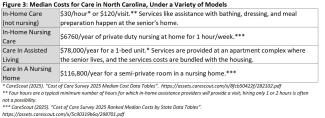
Of seniors age 75+ living alone with very low incomes (<50% of the area median), 92% can’t afford even a single four-hour visit each week by a paid caregiver and only 13% can afford the cost of the median-priced assisted living in their area.[xi][xii] Even for seniors who can afford in-home care, there are insufficient professional in-home care workers in the state to meet the need.[xiii][xiv][xv][xvi]
This gap is often filled by family. In North Carolina, approximately 2.3 million adults (more than a quarter of the adults in the state) provide care for a family member or friend, helping with things like shopping, preparing meals, managing finances and transportation and providing assistance with activities of daily living[xvii], totaling 1.2 billion hours of unpaid care each year.[iii]
Housing and Services Resources for Senior Years
For senior homeowners, home equity may fund housing and other expenses during their senior years. Home Equity Lines of Credit (HELOCs) and Home Equity Conversion Mortgages (HECMs) are mechanisms for homeowners to access the equity in their homes. HECMs, in particular, were designed specifically to help seniors access their homes’ equity during their senior years. Both HELOCs and HECMs depend on the owner having equity in their home and access to credit, and both require the homeowner to keep the home in good condition, continue to occupy the home as their primary residence and continue paying taxes, insurance and utilities. Low-income homeowners tend to have lower dollar values of home equity in their homes than higher-income owners.[ii] Renter households lack home equity, so are more dependent on savings, social security, pensions and retirement accounts.
Common resources to cover services include long-term care insurance[xviii][xix], personal income and savings, life insurance, annuities, trusts and reverse mortgages (like HECMs).[xx] Medicaid pays for long-term care and nursing home services, including personal care, for seniors 65+ with incomes and assets below certain limits.[xxi][xxii] Medicare covers home care services only if the senior is also receiving medically-necessary skilled nursing care at home.[xxiii][xx] Long-term care isn’t a usual part of disability policies. Typically, health insurance covers only specific, limited types of care.
Housing for the Future
North Carolina’s affordable housing shortage requires both adding new, accessible homes and keeping existing homes safe and functional for older adults.
New homes and apartments for seniors are needed, particularly built with accessibility features to accommodate people as they age.[xxiv] The Agency’s Low Income Housing Tax Credit (LIHTC) program funds affordable apartment developments around the state. In the years 2021-2025 the Agency funded 6,020 affordable rental units in senior-targeted properties.
For seniors who prefer and are able to remain in their own homes[i], repairing and adapting the housing they already occupy is a practical, near‑term strategy to support aging in place. The Agency has several programs with this approach. The Urgent Repair Program (URP) makes repairs to seniors’ homes and homes of people with disabilities to enable them to stay rather than having to move because of conditions that threaten their life or safety. The Essential Single Family Rehabilitation Loan Program (ESFRLP) funds full-house rehabilitation, so seniors and people with disabilities can remain in the home they own.
The Displacement Prevention Program (DPP), an Agency partnership with NC Department of Health and Human Services (NC DHHS), provides modifications and enhancements to homes for people with disabilities, so they can remain in their homes. The state’s Area Agencies on Aging connect seniors with resources for home improvements, for example, modifications like ramps and grab-bars that enable seniors to remain in their home longer than they otherwise may have been able to. They also provide other valuable resources for seniors.
To learn more about the Agency, visit its website at www.nchfa.com.
-----------------------------
[i] Pew Research Center (Feb 2026) article “Most older adults who live at home want to age in place, but they aren’t entirely confident they’ll get to”. Available here.
[ii] Harvard Joint Center for Housing Studies (2023). “Housing America’s Older Adults”. Available here.
[iii] North Carolina Coalition on Aging. (2025). “Insights Into Aging in North Carolina”. Available here.
[iv] HUD Section 202 is a supportive housing program in which affordable housing developments for seniors 62+ were developed to include services such as cleaning, cooking, and transportation.
[v] National Council on Aging (July 2026). “Senior Housing Options: A Complete Guide”. Available here.
[vi] NCHFA tabulations of 2024 one-year American Community Survey data, table B25007. Downloaded September 24, 2026.
[vii] North Carolina Coalition on Aging. (2025). “North Carolina Aging Population Profile 2023”. Available here.
[viii] NCHFA tabulations of 2024 one-year American Community Survey data, tables B25072 and B25093. Downloaded September 24, 2026.
[ix] NCHFA tabulations of 2024 one-year American Community Survey data, table B18106, named “Sex by Age by Independent Living Difficulty”. Downloaded September 24, 2026.
[x] AARP research shows an even higher percent—80% of older adults—prefer to receive care in their own homes. Source: Binette, Joanne, and Fanni Farago. 2025 Home & Community Preferences Among Adults 18 and Older. Washington, DC: AARP Research, December 2024. https://doi.org/10.26419/res.00831.005
[xi] Harvard Joint Center for Housing Studies (2023). “Housing America’s Older Adults”, Special Report “The Dual Burden Facing Households with Low and Moderate Incomes”. Available here. The analysis that produced these findings used 2021 National Investment Center for Seniors Housing and Care (NIC) MAP Vision data for assisted living costs, 2021 Genworth Cost of Care Survey data for the costs of care at home, the Elder Index™ produced by the University of Massachusetts Boston, and the 2021 American Community Survey. NIC data was from 97 metro areas in the US.
[xii] Information about costs nation-wide and by state are available from the U.S. Office of Personnel Management (OPM) 2024 “Cost Of Care Survey”. Available here.
[xiii] Paraprofessional Healthcare Institute’s (PHI) website provides information on this topic. Available here. PHI is a nonprofit research and advocacy organization that works to ensure quality care for older adults and people with disabilities by creating quality jobs for direct care workers.
[xiv] AARP (2025) “Tackling the Direct-Care Worker Shortage.” Available here.
[xv] NC DHHS and NC Department of Commerce Report (2024). “Investing in North Carolina’s Caregiving Workforce: Recommendations to strengthen North Carolina’s nursing, direct care, and behavioral health workforce.” Available here.
[xvi] NC Area Health Education Centers Program (AHEC). (2023). “Recommendations for HCBS Worker Certification to the North Carolina Department of Health Benefits”. Available here. This report was commissioned by the NC Department of Health Benefits.
[xvii] National Alliance for Caregiving. (Oct 2025). “Caregiving in the US 2025: North Carolina”. Available here.
[xviii] NC Department of Insurance. Available here.
[xix] National Association of Insurance Commissioners. Available here.
[xx] Administration for Community Living (ACL) within the U.S. Department of Health and Human Services. Available here.
[xxi] MedicaidLongTermCare.org contains a summary of Medicaid for nursing home care, care at home through Aged, Blind, and Disabled Medicaid, and care at home through Home and Community Based Services waivers in North Carolina. Available here.
[xxii] Information about supports available through Medicaid in North Carolina can be found at the NC DHHS Medicaid Long Term Services and Supports webpage. Available here.
[xxiii] Medicare Home Health Services Coverage webpage. Available here.
[xxiv] NC State University Center for Universal Design (1997). “The Principles of Universal Design”. Available here.